
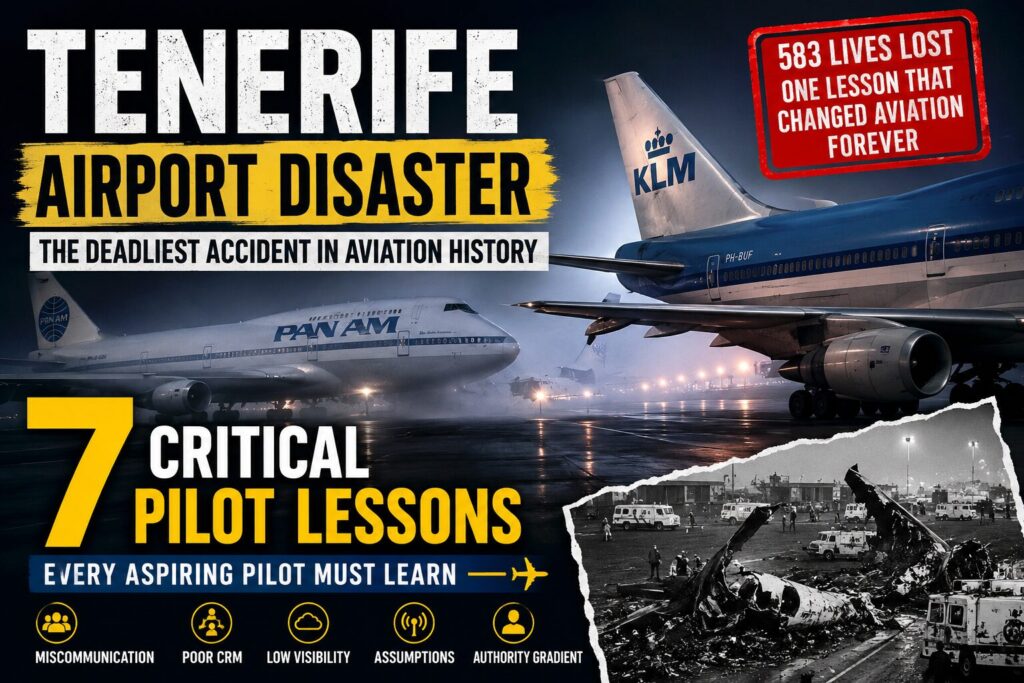
Tenerife Airport Disaster: 7 Critical Pilot Lessons
The Tenerife Airport Disaster remains the deadliest aviation accident in history. Two Boeing 747 aircraft collided on the runway due to communication failures, poor Crew Resource Management (CRM), assumptions, and low visibility, resulting in 583 fatalities.
This accident completely changed aviation training worldwide. Today, CRM, standard phraseology, cockpit communication discipline, and First Officer assertiveness training are mandatory because of the lessons learned from Tenerife.
Table of Contents
- What Happened in the Tenerife Airport Disaster?
- Why Is Tenerife Important for Aspiring Pilots?
- What Caused the Tenerife Runway Collision?
- How Did CRM Change After Tenerife?
- What Communication Lessons Should Pilots Learn?
- How to Become a Pilot in India
- Eligibility Criteria for CPL in India
- Step-by-Step Process to Become a Pilot
- Pilot Training Cost in India
- CPL vs Cadet Program
- Career Opportunities After CPL
- Common Mistakes Aspiring Pilots Must Avoid
- FAQs
What Happened in the Tenerife Airport Disaster?
The Tenerife Airport Disaster occurred on 27 March 1977 at Los Rodeos Airport in Spain when two Boeing 747 aircraft operated by KLM and Pan Am collided during takeoff.
The accident happened because of:
- Miscommunication between pilots and ATC
- Poor visibility due to dense fog
- Incorrect assumptions
- Poor Crew Resource Management (CRM)
- Authority gradient inside the cockpit
| Factor | Details |
|---|---|
| Date | 27 March 1977 |
| Location | Tenerife, Spain |
| Aircraft | KLM Boeing 747 & Pan Am Boeing 747 |
| Fatalities | 583 |
Read the official aviation accident summary here: Detailed Tenerife Accident Analysis
Why Is Tenerife Important for Aspiring Pilots?
The Tenerife Airport Disaster changed aviation training forever. It became the foundation for modern Crew Resource Management (CRM) programs worldwide.
Today, aspiring pilots are trained extensively in:
- Communication skills
- Threat and Error Management (TEM)
- Situational awareness
- Cockpit teamwork
- Decision-making under pressure
Students preparing for DGCA examinations at Airline Prep School (ALPS) are introduced to real aviation case studies to improve operational thinking and cockpit discipline.
What Caused the Tenerife Runway Collision?
The Tenerife accident was caused by multiple human-factor failures happening together.
1. Miscommunication
The KLM captain misunderstood ATC communication and believed takeoff clearance had been issued.
2. Authority Gradient
The First Officer hesitated to strongly challenge the captain’s decision.
3. Poor Visibility
Dense fog prevented both crews from seeing each other on the runway.
4. Radio Interference
Simultaneous radio transmissions blocked critical communication.
How Did CRM Change After Tenerife?
The Tenerife Airport Disaster directly led to mandatory CRM training across the aviation industry.
CRM focuses on:
- Leadership
- Communication
- Decision-making
- Situational awareness
- Team coordination
| Before Tenerife | After Tenerife |
|---|---|
| Captain-dominated cockpit culture | Collaborative cockpit communication |
| Informal phraseology | Standardized communication |
| Minimal CRM training | Mandatory CRM worldwide |
Learn more about DGCA pilot licensing regulations: DGCA Official Website
What Communication Lessons Should Pilots Learn?
The Tenerife disaster proved that communication errors can become fatal even when experienced pilots are involved.
- Never assume clearance
- Use standard phraseology
- Confirm all instructions clearly
- Challenge unsafe decisions immediately
- Maintain situational awareness continuously
After Tenerife, the word “takeoff” became restricted only for actual takeoff clearance.
How to Become a Pilot in India
To become a pilot in India, students must complete DGCA-approved training and obtain a Commercial Pilot License (CPL).
Basic Process
- Complete Class 12 with Physics & Mathematics
- Clear DGCA Medicals
- Join Ground School
- Complete Flying Training
- Pass DGCA Exams
- Apply for CPL
Read our complete guide: How to Become a Pilot in India
What Are the Eligibility Criteria for CPL in India?
| Requirement | Criteria |
|---|---|
| Education | 10+2 with Physics & Mathematics |
| Minimum Age | 17 Years |
| Medical | DGCA Class 1 Medical |
| English Proficiency | Required |
Strong communication and decision-making skills are equally important for aspiring pilots.
Step-by-Step Process to Become a Pilot
Step 1: Complete Class 12
Physics and Mathematics are mandatory subjects.
Step 2: Obtain DGCA Medical
Students must clear DGCA Class 2 and Class 1 medical examinations.
Step 3: Join Ground School
Subjects include:
- Air Navigation
- Meteorology
- Air Regulations
- Technical General
Step 4: Flying Training
Students complete approximately 200 flying hours.
Step 5: Clear DGCA Exams
Students must pass all DGCA theory examinations.
Step 6: Obtain CPL
DGCA issues the Commercial Pilot License after all requirements are completed.
What Is the Cost of Pilot Training in India?
| Training Component | Estimated Cost |
|---|---|
| Ground School | ₹1.5–3 Lakhs |
| Flying Training | ₹35–55 Lakhs |
| Medical & Licensing | ₹1–2 Lakhs |
| Total Estimated Cost | ₹40–60 Lakhs |
CPL vs Cadet Program
| Feature | CPL Route | Cadet Program |
|---|---|---|
| Flexibility | High | Limited |
| Airline Tie-Up | Not Guaranteed | Usually Included |
| Cost | Variable | Higher |
| Selection Difficulty | Moderate | Highly Competitive |
Explore our cadet preparation programs: Pilot Cadet Program Preparation
Career Opportunities After CPL
- Airline First Officer
- Charter Pilot
- Cargo Pilot
- Flight Instructor
- Corporate Aviation Pilot
| Role | Estimated Salary |
|---|---|
| Fresher First Officer | ₹1.5–4 Lakhs/month |
| Senior Airline Pilot | ₹6–12 Lakhs/month |
Common Mistakes Aspiring Pilots Must Avoid
- Ignoring communication skills
- Overconfidence
- Poor checklist discipline
- Weak situational awareness
- Ignoring CRM principles
The Tenerife accident demonstrated that aviation safety depends heavily on teamwork and communication, not just technical flying ability.
FAQs
What caused the Tenerife Airport Disaster?
The accident was caused by miscommunication, assumptions, poor CRM, low visibility, and radio interference.
Why is Tenerife important in aviation training?
It transformed global aviation safety standards and led to mandatory CRM training.
What is CRM in aviation?
CRM stands for Crew Resource Management and focuses on communication, teamwork, leadership, and decision-making.
How can I become a pilot in India?
Students must complete DGCA-approved training, flying hours, medicals, and obtain a CPL.
What is the average CPL cost in India?
CPL training in India generally costs between ₹40–60 Lakhs.
Conclusion
The Tenerife Airport Disaster remains one of aviation’s most important learning moments. It proved that communication, discipline, CRM, and decision-making are just as important as technical flying skills.
Aspiring pilots should study aviation accidents to develop stronger operational awareness and safer cockpit habits.
At Airline Prep School (ALPS) , students receive DGCA-focused training along with real-world aviation learning that prepares them for modern airline operations.
Book Your Free Pilot Career Counselling Session
Airline Prep School (ALPS) offers:
- DGCA Ground Classes
- CPL Preparation
- Pilot Cadet Program Training
- Psychometric Preparation
- Airline Interview Preparation
- Demo Lectures
Mumbai Center
B Wing 103, Rassaz Castle, Opp. Gundauli Bus Stop, Near Western Express Highway Metro Station, Malpa Dongri, Andheri East, Mumbai, Maharashtra 400093
Pune Center
Second Floor, Above Ganesh Bhel, Opp. FC College Main Gate, Fergusson College Rd, Shivajinagar, Pune, Maharashtra 411004
Visit: Contact Airline Prep School
```